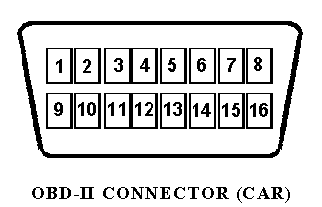
|
Pin No. |
Description |
Pin No. |
Description |
|
1 |
OEM specific |
9 |
OEM specific |
|
2 |
Bus + Line, SAE J1850 |
10 |
Bus - Line, Sae J1850 |
|
3 |
OEM specific |
11 |
OEM specific |
|
4 |
Ground, Chassis |
12 |
OEM specific |
|
5 |
Ground, Signal |
13 |
OEM specific |
|
6 |
OEM ( CAN High , J-2284 ) |
14 |
OEM ( CAN Low , J-2284 ) |
|
7 |
K Line, ISO 9141 |
15 |
L Line, ISO 9141 |
|
8 |
OEM specific |
16 |
Positive, Vehicle Battery |
Pins 4, 5, 7, 15, 16 = ISO 9141-2.
Pins 2, 4, 5, 10,
16 = J1850 PWM.
Pins 2, 4, 5, 16 =
J1850 VPW.
Protocol ISO 9141-2 can be identified by pin 7 and by the absence of pins 2 or 10 in the diagnostic socket. If pin 7 is absent, the protocol would be SAE J1850 VPW (Variable Pulse Width Modulation) or SAE J1850 PWM (Pulse Width Modulation). All protocols are using the standard OBD-II J1962 connector.
OBDII Codes example:
Code readers worth they money will give you the code explanation too. Some even have troubleshooting guides for each trouble code. P 0 2 0 4 - is the code your code reader has identified L 1 2 3 4 So we have a Letter & 4 Digits after it. Let's try to decipher it: The Letter: - identifies the type of trouble code based on the following: P = Powertrain (Engine & Gearbox) These codes are generated by either the powertrain control module (PCM), engine control module (ECM), or transmission control module (TCM). B = Body (read "comfort") Body ("B") codes, are set by the body control module (BCM) and pertain to climate control, lighting, and electronically operated & regulated accessory systems. C = Chassis (read "ride") These codes define problems in the traction control, variable assist steering, automatic load leveling, and other systems that regulate vehicle dynamics. U = Network (between the ECU's) Network (new) - codes generated when malfunction of the network message/s traffic between vehicle computers (ECU's) is detected (Undefined DTC's-SAE old) 1st digit: - specifies whether or not the code is Standard or Manufacturer Specific 0 = Standard Standard (Generic) trouble codes which manufacturers have to include (by SAE) 1 = OEM Manufacturer specific trouble codes which may or may not be included or read 2nd digit: - narrows down the code to a specific system of the vehicle (shown here for P only) 1 = Emission management i.e. Codes related to emission management, fuel or air metering 2 = Injector circuit/s 3 = Ignition circuit/s 4 = Auxiliary emission Codes related to Auxiliary emission Control/s 5 = Vehicle speed & idle control 6 = Computer & output circuit ECU's internal and/or external (wiring, power supply, etc.etc.) trouble codes 7 = Transmission Control/s 8 = Transmission Control/s 9 = SAE ( reserved for future use) 0 = SAE ( reserved for future use) 3th & 4th digits: - represent the specific Diagnostic Trouble Code (DTC) 0 4 Some Generic (only) OBDII trouble code explanations can be found here The full OBDII look up table can be bought here. P 0 2 0 4: So to sum it up - Code P0204 = Powertrain, Standard (generic code), Injector circuit, Code 04 The trick now is to know what 04 is... = Injector Circuit Malfunction - Cylinder N:4 Note: If you encounter P1xxx, B1xxx, C1xxx, U1xxx code, then it's Manufacturer Specific code and your code reader may or may not read & interpret it. The interpretation of those codes is closely guarded by the vehicle manufacturers although it can be bought from them for the right price. If your Code Reader manufacturer has bought them, then it should be able to read & interpret those codes. Read more about it here...
OBD-II TERMINOLOGY This table covers the new standardized OBD-II terms and acronyms.
If you still can't find what you are looking for below, then check our web links.
| OBD-II | Previous Term's | |
| ENGINE CONTROLS | PCM (Powertrain Control Module) | ECA, ECM, ECU, SMEC |
| MIL (Malfunction Indicator Lamp) | CHECK ENGINE,
MAINTENANCE REQUIRED SERVICE ENGINE SOON, POWER LOSS | |
| VCM (Vehicle Control Module) | ECA, ECM, ECU, SMEC, PCM | |
| SENSORS | IAT (Inlet Air Temperature) | ACT, ATS , MAT |
| ECT (Engine Coolant Temperature) | ECT, CTS, THA | |
| TP (Throttle Position) | TPS | |
| BARO (Barometric Pressure) | ALTITUDE, APS | |
| MAP (Manifold Absolute Pressure) | MAP | |
| MDP (Manifold Differential Pressure) | VACUUM SENSOR | |
| MAF (Manifold Air Flow) | AFC, VAF, AIRFLOW | |
| KS (Knock Sensor) | KNOCK SENSOR | |
| O2S (Oxygen Sensor) | O2, EGO, LAMBDA SENSOR | |
| HO2S (Heated Oxygen Sensor) | HEATED O2, HEGO | |
| CKP (Crankshaft Position) | CRANKSHAFT SENSOR | |
| CMP (Camshaft Position) | CAM, CID | |
| ACTUATORS | IAC (Idle Air Control) | AIR BYPASS SOLENOID, IAC |
| ISC (Idle Speed Control) | IDLE SPEED AIR VALVE, IDLE SPEED MOTOR, ISC | |
| ICM (Ignition Control Module) | TFI IV, HEI, IGNITER | |
| MC (Mixture Control) | M/C SOLENOID, FBC | |
| TCC (Torque Converter Clutch) | TCC, Lock-Up Switch, Lock-up Solenoid | |
|
|
Automotive Equipment - in tune with the Future
